

Community Resilience
When Disaster Strikes, We're Already Here
Resilience is not a program we launched. It is who we are.
Long before a disaster reaches our region and long after the news trucks leave, United Way is in the community, working alongside the neighbors, businesses, and local partners who call it home. That is what makes our resilience work different: we are not an outside agency parachuting in. We live here. We stay here. And we are building the systems that help Northwest Florida prepare, respond, and recover, together.
A National Network Built for Long-Term Recovery
 United Way operates in more than 1,100 communities worldwide, which means that when disaster hits one of us, an entire network is ready to respond. Across the country, that shows up as:
211, the free, 24/7 helpline that connects people to food, shelter, financial assistance, and emergency resources in more than 180 languages, staffed by thousands of caring experts who field tens of thousands of calls a day
Disaster preparedness programs that help communities get ready before a crisis hits, from wildfire mitigation to hurricane readiness workshops to emergency planning support for local businesses and nonprofits
Long-term recovery leadership that continues for months and years after a disaster, long after immediate relief funding and media attention have moved on
United Way's philosophy is simple: disasters are becoming more frequent and more complex, and recovery has to be a sustained, coordinated effort, not a one-time response. That is the model we bring home to Northwest Florida.
Northwest Florida's Resilience Story Started With Hurricane Michael
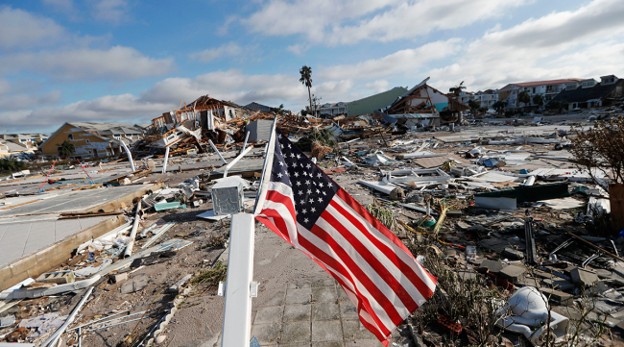
On October 10, 2018, Hurricane Michael tore through the Florida Panhandle as one of the strongest storms ever to make landfall in the continental United States. United Way of Northwest Florida's own building was damaged so badly we didn't return to it until nearly four years later. However, within hours of the storm, our team suspended business as usual and moved straight into relief and recovery mode, helping stand up the county's Volunteer Reception Center and working shoulder to shoulder with the Emergency Operations Center.
In the years since, that response has grown into something bigger: a standing commitment to community resilience across our entire six-county region.
What that has looked like on the ground:
- Establishing the Hurricane Michael Relief Fund, which has distributed more than $500,000 directly to local nonprofits serving families across Bay, Calhoun, Gulf, Holmes, Jackson, and Washington counties
- Supporting the launch of Rebuild Bay County, providing critical resources throughout the long recovery process and building lasting disaster resilience infrastructure for the region
- Strengthening 211 Northwest Florida, which leaned on a nationwide network of 211 call centers, from Los Angeles to Kentucky to Pennsylvania, to keep help flowing to residents around the clock in the weeks after Michael
- Being selected as one of only two organizations nationwide to receive a Community Resiliency Grant from United Way Worldwide, a $100,000 investment strengthening disaster preparedness and relief efforts across our region
- Piloting United Way Worldwide's new Community Resilience pillar, one of only three United Ways in the country doing so, with the goal of making resilience a signature part of how we serve Northwest Florida
- Working alongside Rebuild Bay County, re+connect and Carnegie Mellon University to help turn the AD Harris campus into a physical resilience hub, with plans for smaller neighborhood hubs in Glenwood, Millville, and The Hill, and a vision to eventually reach all six counties
- Grounding this work in ALICE (Asset Limited, Income Constrained, Employed), because financial resilience, the ability to withstand a shock without falling into crisis, is at the heart of a truly resilient community
- Pursuing grant funding alongside our partners to bring more resources home to Northwest Florida
Investing in Local Solutions
Resilience isn't only about how we respond after a storm, it's about the strength of the network already in place before one hits. Through our Community Impact Fund, United Way strategically funds affiliated partner agencies working on disaster preparedness, emergency assistance, and long-term recovery support, making sure Northwest Florida has a strong bench of organizations ready to respond the moment our neighbors need them.
As President and CEO Gina Littleton puts it: "You never know when it's going to be you. We never know what month it's going to happen, and we don't know where the cards are going to fall. And I think the only way to make that a little bit easier is to be ready. And that means all of us. It doesn't just mean my disaster plan at my house. It means our business community, our nonprofit community, municipalities, county governments, individuals, and families."
That belief, that resilience is everyone's responsibility and everyone's benefit, is the foundation for everything that follows.
The Community Resilience Center at AD Harris
Our resilience work is taking shape in a physical home. Alongside Rebuild Bay County, we're helping to develop the AD Harris Learning Village into a central hub where preparation, response, and recovery come together for Northwest Florida families, with a vision for neighborhood-level resilience hubs to follow across the region. Learn more about the Community Resilience Center
See Our Resilience Work in Action
Because Readiness Is a Team Effort
Hurricane Michael taught Northwest Florida a hard lesson: recovery is long, and no single organization can carry it alone. Every workshop, every dollar granted, every partnership we build is about making sure that the next time disaster strikes, our community is not starting from zero. We will be ready, and we will be ready together. Because United, We Thrive.